
What is employee onboarding automation?
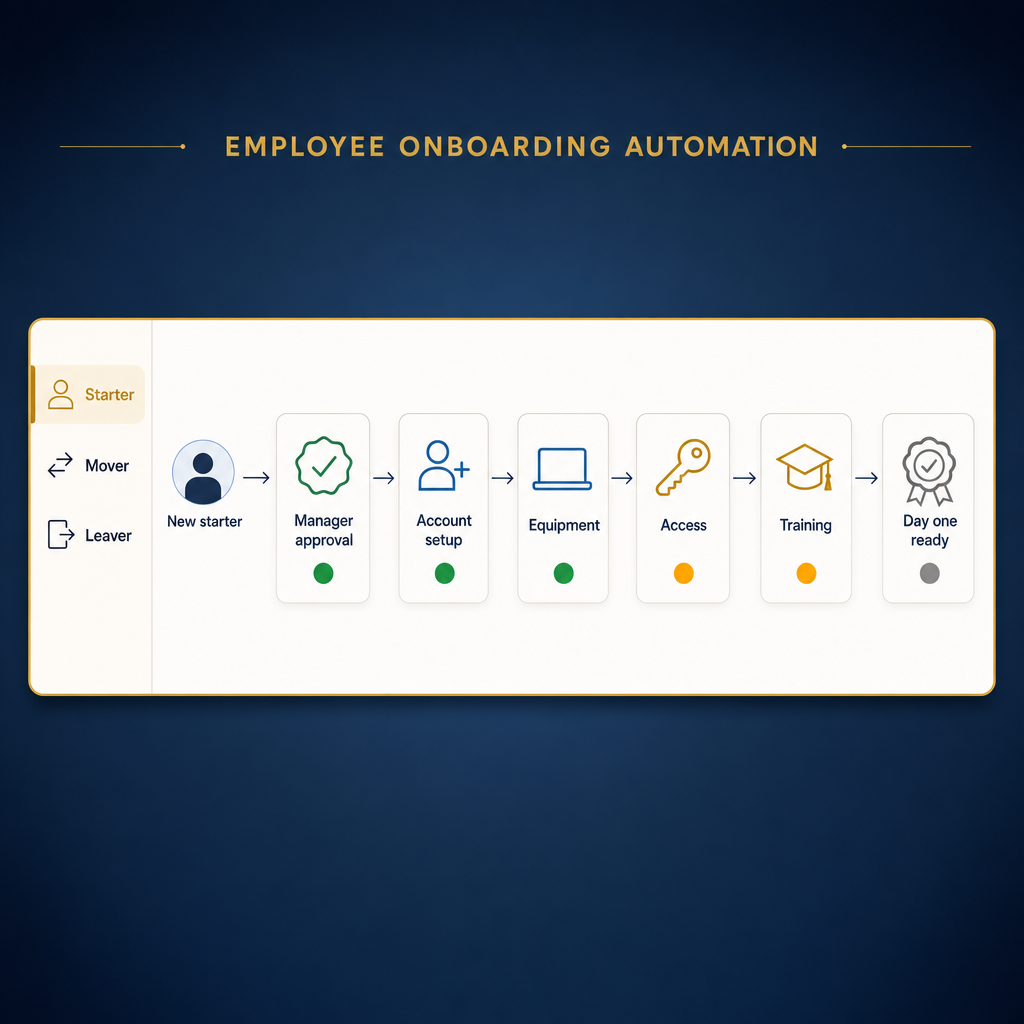
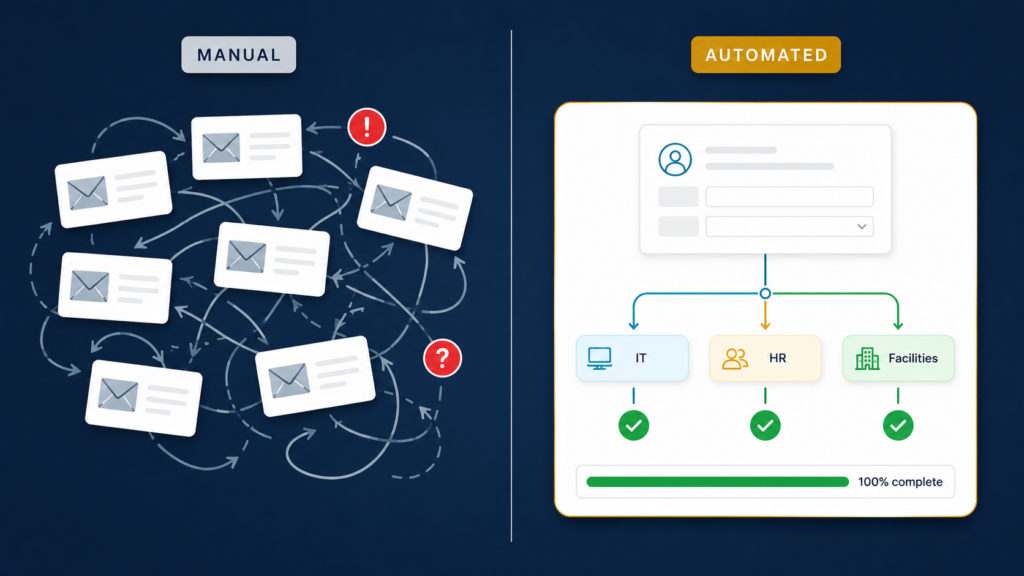
Employee onboarding automation is software for the manual steps around a new hire, a role change or a leaver. It runs them as a digital form plus an automatic workflow. Instead of one person emailing IT, HR and Facilities and hoping, a single form kicks off every task, routes it to the right people, and logs each one as complete.
In practice this is the “starters, movers and leavers” process, often shortened to SML. A starter needs accounts, equipment, access and induction. A mover needs permissions changed when they switch role. A leaver needs all of it switched off, cleanly and on time. Automation makes those three journeys run the same way every time.
It sits within the wider field of business process automation: no-code forms, approval routing and workflow rules applied to the repetitive admin that quietly eats a small team’s week.
Why does manual onboarding cost UK SMEs more than they think?
The cost of manual onboarding rarely shows up as a line in the budget, which is exactly why it hurts. It shows up as a slow first week, a poor first impression, and a manager chasing five departments to get one person working.
The first day matters more than most owners assume. Glassdoor’s onboarding research widely ties a strong, structured first day to roughly 82% better new-hire retention. The opposite is also true: a new starter who spends day one waiting for a laptop forms a view of how the place is run, and it is hard to undo.
There is a hidden admin tax too. Every starter pulls a manager away from real work to coordinate accounts, hardware and training. Do that a handful of times a year, by email, and the hours add up to a salary nobody is tracking.
The leaver problem nobody owns
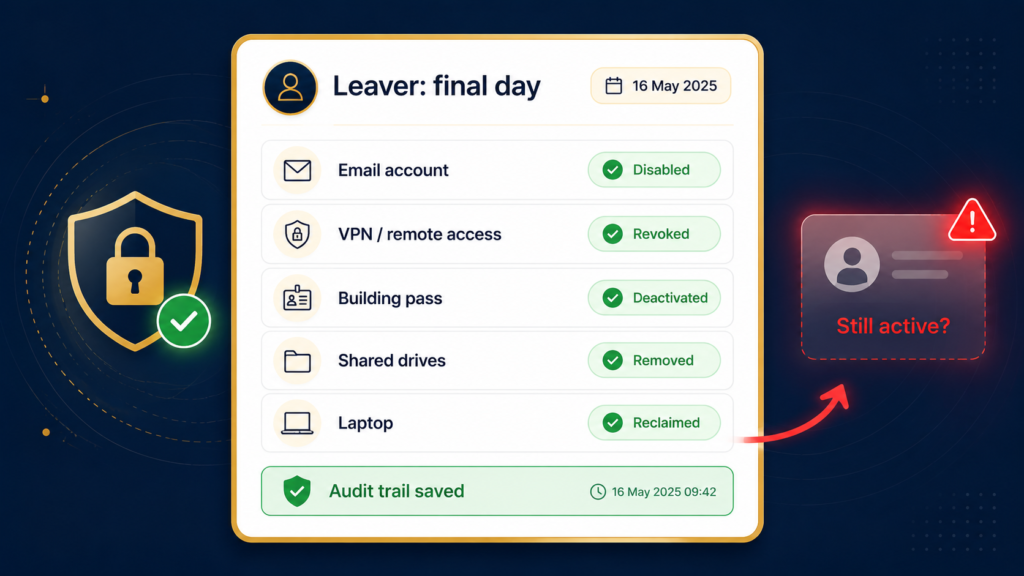
Offboarding is the part of the process most likely to go wrong, because once someone has left, there is no one chasing it. The new starter complains when their account is not ready. A leaver’s forgotten login complains to no one, which is precisely the problem.
It is also a real security and compliance risk, not just untidiness. 43% of UK businesses experienced a cyber breach or attack in the last year (GOV.UK Cyber Security Breaches Survey, 2025), and a former employee who still has a live account is one of the quieter ways in. The same survey found 68% of businesses restrict access rights to specific users, but restricting access only protects you if you also remove it the day someone leaves.
Automation closes that gap. A leaver form triggers the de-provisioning steps at once: disable accounts, revoke access, reclaim equipment, and leave a dated record that it was done. No memory required.
What should a UK SME automate first?
Start where the process repeats and crosses departments, because that is where manual handovers break. For most UK SMEs that means the new-starter setup and the leaver shutdown first, then role changes once those two run cleanly.
A sensible first build covers the obvious tasks in one form: create accounts, order or assign equipment, grant the right access, assign induction and any mandatory training, and notify the manager when each step is done. The same pattern, reversed, becomes your leaver process.
What you do not need to automate is the human part. A warm welcome, an introduction to the team, a manager who actually checks in: keep those personal, because they are exactly what Acas puts at the centre of a good staff induction. Automation should remove the admin so your people have time for the parts that earn loyalty, not replace them.
Does your UK SME actually need to automate onboarding?
If you hire once or twice a year, a good checklist and a shared folder may genuinely be enough, and buying workflow software would be premature. Be honest about your real volume before you spend.
You probably do need automation if any of these are true: you hire or change roles often enough that the manual version has become a drag; your setup spans several systems (email, HR, finance, building access); you work across sites so no single person sees the whole process; or you are regulated and need to evidence that access was granted and removed correctly.
The quick test is the leaver test. Can you prove, today, that everyone who left in the past year had every account closed on their last day? If that question makes you uneasy, that unease is the gap automation fills.
Standalone onboarding app, or built into your platform?
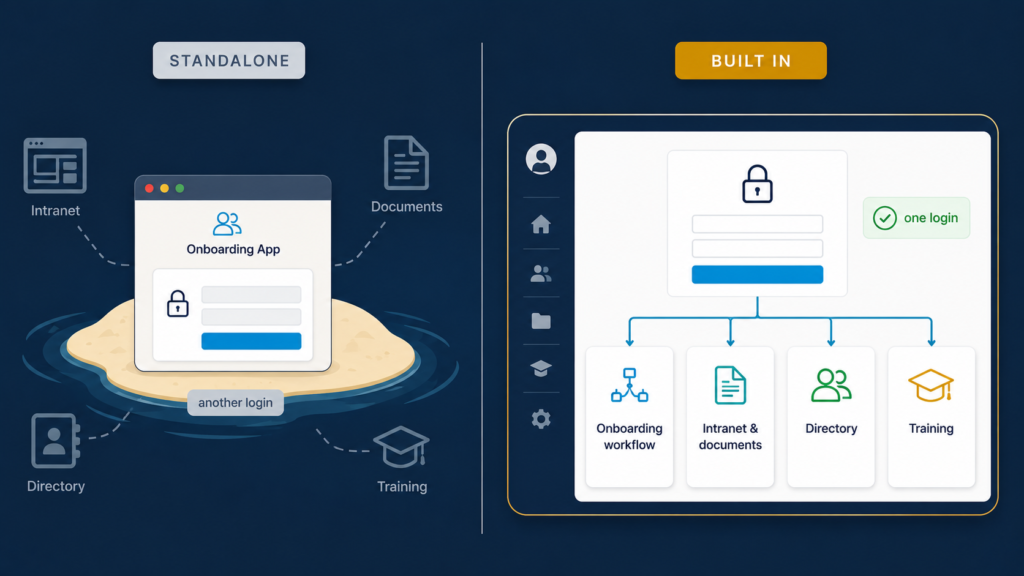
For most UK SMEs, the better answer is onboarding built into the platform you already run, not a separate onboarding app that becomes one more login. When the workflow lives beside your intranet, documents and directory, a new starter’s form can trigger their induction, their reading, and their access in the same place.
Here is the practical difference:
| Factor | Standalone onboarding app | Built into your platform |
|---|---|---|
| Logins | Another system to manage | One login with your intranet |
| Where it sits | Apart from your other tools | Can assign induction and courses in the same flow |
| Training | Separate hand-off to an LMS | Can assign induction and courses in the same flow |
| Leavers | Often onboarding only | Same workflow, reversed, for clean offboarding |
| Best for | Pure recruiting at volume | Internal starters, movers and leavers at a typical UK SME |
We take this approach with Claromentis business process automation, which runs the whole starters, movers and leavers process as one workflow inside the Claromentis digital workplace. Setup and shutdown live with the people and tools they touch.
How do you set up onboarding automation?
Start with the process you actually have, not the one you wish you had. Map a real new starter, step by step, and note who does what and where it stalls. The stalls are what you automate.
From there, the build is straightforward with a no-code workflow tool:
- Turn the steps into a single digital form.
- Route each task to the right team, with approvals where they are needed.
- Set reminders so nothing sits waiting.
- Connect the systems you already use, so accounts and access are not keyed in twice.
- Build the leaver version as the mirror image of the starter form.
The bottom line for UK SMEs
Employee onboarding automation is not about replacing the human welcome. It is about removing the admin that makes the welcome go wrong: the missing laptop, the access that never arrived, the leaver who still has a login in June. Get the repetitive parts running the same way every time, and your managers get their week back while your security and compliance quietly improve.
For most UK SMEs, the route that lasts is automation built into the platform you already run. Starters, movers and leavers then live with the people and tools they touch, not in yet another system.
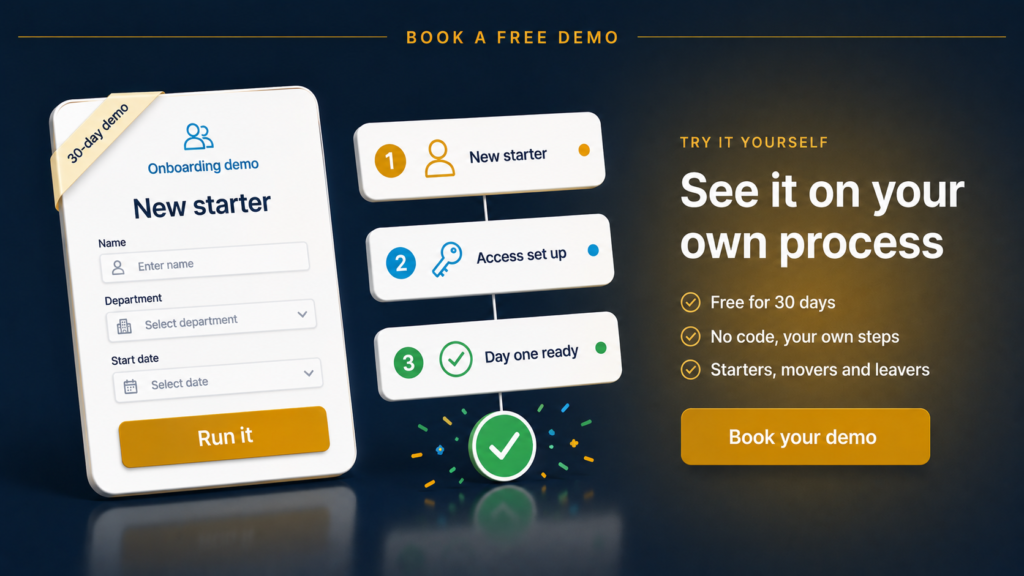
See it on your own process before you decide. We’ll set up a free 30-day Claromentis demo playground with a working starters, movers and leavers workflow, so you can run a new starter and a leaver through it with your own steps.